.svg)
.svg)


.png)
.png)
What is a CT Coronary Angiography?
A CT Coronary Angiography, often shortened to CTCA, is a non-invasive scan that produces detailed pictures of the arteries that supply blood to your heart.
Unlike a traditional angiogram, which uses a catheter threaded through your blood vessels, a CTCA uses a fast CT scanner and a contrast dye given through a small needle in your arm. The scanner is timed to your heartbeat so it captures the clearest possible images of the small coronary arteries.
To get the best picture, most people are given medication to gently slow the heart rate, and a spray under the tongue to widen the coronary arteries. This helps the scan show any narrowing or plaque that could affect blood flow to the heart.
What a CTCA can help find
Your GP, cardiologist or specialist may refer you for a CTCA to investigate or monitor things like:
- Chest pain when coronary artery disease is suspected but not yet confirmed
- Unexplained shortness of breath, or an abnormal stress test that needs clarification
- Strong family history of early heart disease
- Risk factors such as high blood pressure, diabetes, high cholesterol or being a longterm smoker
- Pre-operative assessment before non-cardiac surgery, where heart risk needs to be checked
- Existing bypass grafts or stents that need follow-up imaging
- Atypical chest symptoms that may or may not be heart-related

About 20 mins.
On the scanner

2–3 hours
Total time at the clinic

Bring a driver
Heart-rate medication may cause drowsiness
What to expect on the day
- Check in and monitoring
You check in at reception with your referral and Medicare card. We measure your heart rate and blood pressure, and place small adhesive pads on your chest so we can monitor your heartbeat during the scan. - Heart-rate medication
If your heart rate is above about 60 to 65 beats per minute, you may be given medication (beta-blockers) to gently slow it down. This usually takes 45 to 90 minutes to take effect, which is why your appointment runs longer than the scan itself. - Cannula and contrast
A small plastic tube called a cannula goes into a vein in your arm so we can give you the contrast dye during the scan. You may also be given a spray under your tongue, which briefly widens the coronary arteries so we can see them more clearly. - On the scanner
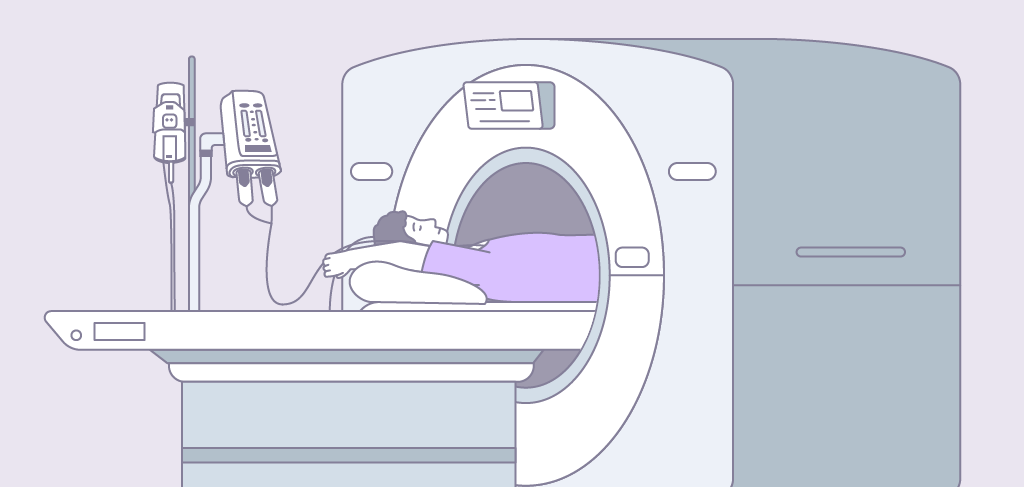
You lie on a padded table that slides through a short, open scanner ring. You'll be asked to hold your breath for short periods (5 to 15 seconds) so the images stay sharp. The radiographer talks to you through the intercom throughout. - Brief observation, then home
We monitor you for a short period after the scan to make sure you feel well, then you can go home. Drink plenty of water for the rest of the day to help your body clear the contrast dye.
Tell us before your scan if you:
- Have kidney problems, or a recent test showing reduced kidney function
- Have asthma, thyroid conditions, or any serious allergies
- Have previously reacted to contrast dye or iodine
- Have a known heart condition such as severe aortic stenosis or an irregular rhythm
- Take medication for erectile dysfunction (Viagra, Cialis, Levitra, Spedra) — we'll talk through timing
- Are pregnant, think you might be, or are breastfeeding
These details help us plan your scan safely. Your referring doctor and our radiologist will decide how best to proceed.
Before you come in
Preparation matters for CTCA, because caffeine and a fast heart rate make the images harder to read. We send the exact instructions when you book. In general:
Food and drink
Hydrate well in the days before your scan. Don't eat for two hours before your appointment, but water is fine.
No caffeine for 24 hours
This is important. Avoid coffee, tea (including herbal), chocolate, cola and energy drinks for the full 24 hours before your scan. Caffeine speeds up your heart and can make the scan harder to interpret.
No smoking for 12 hours
Smoking also affects your heart rate and coronary arteries. Avoid it for 12 hours before your appointment.
Avoid strenuous exercise
Take it easy on scan day. No gym, no running.
Medications
Take your regular medications as usual, unless your doctor tells you otherwise. Do not take erectile dysfunction medication in the days before your scan — call us if you're unsure of the timing.
What to bring
- Your referral letter from your GP, cardiologist or specialist
- Medicare card, and private health card if you have one
- A recent kidney function blood test, if your doctor asked for one
- A list of your current medications
- Any previous heart scans or cardiac reports
- Comfortable clothing without metal near your chest
- A driver if possible, in case the heart-rate medication makes you drowsy
What it looks like
A short walkthrough showing the room, the scanner and what happens during a CTCA appointment.
Cost and results
- What it costs
CTCA usually has an out-of-pocket cost with a Medicare rebate where eligible. We confirm the exact cost when you book.
Read our billing information - How you'll see results
Your report and images are sent electronically to your referring doctor, usually within 3-5 Business Days.
Access the patient portal
Frequently Asked Questions
How should I prepare for a CTCA?
.png)
Hydrate well in the days before, then fast for two hours before your appointment (water is fine). Avoid all caffeine for 24 hours and smoking for 12 hours beforehand. Don't do strenuous exercise on the day.
Take your regular medications unless your doctor tells you otherwise. Do not take erectile dysfunction medication in the days before — call us about timing.
Why do I have to avoid caffeine?
Caffeine speeds up your heart and makes the scan harder to interpret. The clearest CTCA images are taken when your heart is beating slowly and steadily, so avoiding caffeine for the full 24 hours before makes a real difference to image quality.
Why might I be given heart-rate medication?
The clearest pictures of the coronary arteries are taken when the heart is moving slowly. If your heart rate is above about 60 to 65 beats per minute when you arrive, we may give you a beta-blocker tablet or injection to slow it gently. This is the main reason your appointment runs longer than the 20-minute scan.
Will I feel anything during the scan?
The X-ray scan itself doesn't hurt. You won't feel the X-rays.
When the contrast dye is given, you may notice a brief warm flush spreading through your body and a metallic taste in your mouth. The spray under your tongue may give you a brief headache or feeling of fullness in the head. All of this passes within a minute or two.
How long does a CTCA take?
The scan itself takes about 20 minutes. Allow 2 to 3 hours at the clinic in total to cover check-in, heart-rate medication (if needed), the scan and a short period of monitoring afterwards.
Do I need a referral?
Yes. CTCA needs a referral from your GP, cardiologist or specialist. Bring the original on the day, or have a photo of it on your phone when you book.
Can I drive home afterwards?
If you've had heart-rate medication, we recommend bringing a driver. Beta-blocker can sometimes cause tiredness or lightheadedness, especially if it's the first time you've taken one. If you haven't needed any medication, you can drive yourself.
How does CTCA compare to a traditional angiogram?
A traditional invasive angiogram involves threading a thin catheter into your blood vessels from the wrist or groin. A CTCA produces similar pictures of the coronary arteries without going inside the body, using a CT scanner and a contrast dye given through a vein in your arm.
CTCA is often used as the first investigation. If it shows significant narrowing, a traditional angiogram may still be needed to treat it.
What if I'm pregnant?
Tell us before your appointment if you're pregnant or think you might be. Your referring doctor and our radiologist will decide whether a CTCA is appropriate, or whether a different test would be more suitable.
Does CTCA use more radiation than a regular CT?
CTCA uses more radiation than a plain X-ray. We use low-dose cardiac CT techniques to keep exposure as small as practical while still getting clear images. Your referring doctor will decide whether the diagnostic benefit is appropriate for your situation.
Ready to book?
.png)
Visit us

Shop TO3, Ground Floor, 2107-2125 Dandenong Road, Clayton VIC 3168
.svg)
1300 101 695
.svg)
9am - 5pm Weekdays
Saturday: By appointment only
Saturday: By appointment only

.svg)

.svg)
.svg)
.svg)